iGrill 2 vs iGrill 3: The Differences, and How to Check Any Bluetooth Grill Thermometer at Home
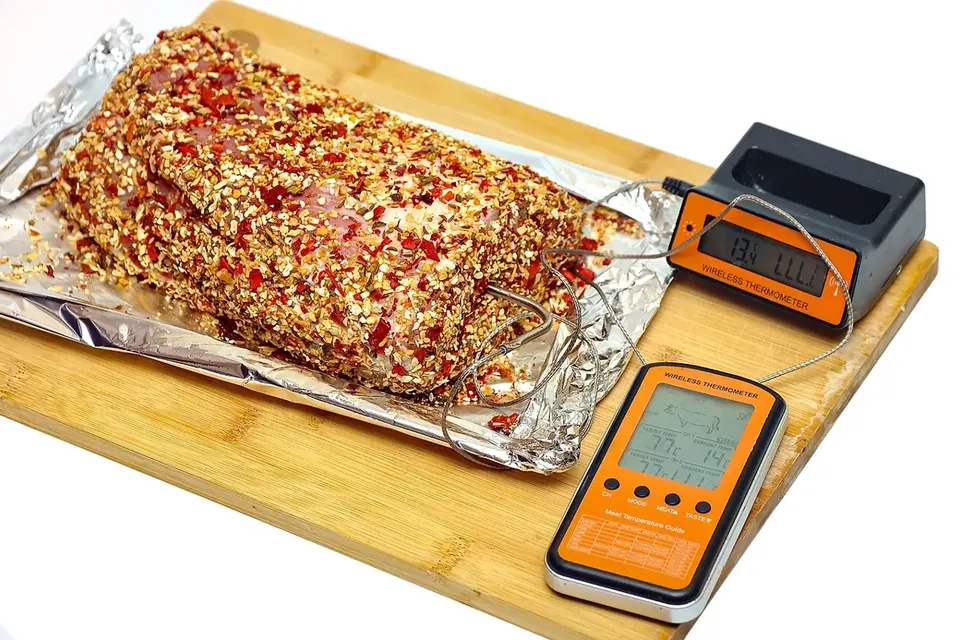
The iGrill 2 and iGrill 3 are Bluetooth thermometers that send probe readings to a phone app so you can follow a cook without lifting the lid. Both were sold under the Weber brand, and both still turn up second-hand and in sheds. The key difference is not accuracy or range but where the unit lives: the iGrill 2 is a standalone, magnetic hub for any grill, while the iGrill 3 was made to mount on specific Weber gas grills. This guide sets out the published differences and, more usefully, how to check any probe thermometer before trusting it with dinner.
Hob & Ember has no affiliation with Weber or any retailer. Specifications below are taken from manufacturer and retailer descriptions and may vary by production run and region; the manual for your unit is the final word.
Side by side
| iGrill 2 | iGrill 3 | |
|---|---|---|
| Mounting | Freestanding, magnetic back | Fixed mount on compatible Weber gas grills |
| Compatibility | Any grill, smoker or oven (probe cable through the door) | Weber Genesis II, Genesis II LX and Spirit II models with the iGrill 3 mount |
| Probe ports | 4 | 4 |
| Probes in the box | Typically 2 meat probes | Varies by package |
| Power | AA batteries; manufacturer figure around 200 hours | Batteries; published figures vary by source |
| Connection | Bluetooth to phone app | Bluetooth to phone app |
| Extra features | Temperature alarms, presets, LED indicators | Temperature alarms, presets; app also offered a propane-level feature on some grills with a fuel gauge |
If you own a compatible Weber gas grill and like everything permanently in place, the iGrill 3 was the neater option. If you cook on a kettle, a smoker or several grills, the iGrill 2's portability matters more. Probes themselves are similar in design; check that replacements are listed as compatible with your hub.
Apps, support and second-hand units
Both devices depend on a phone app. Weber has changed its app line-up over the years, and some owners report that features or the original iGrill app have changed. Before buying a used unit, check the current app listing in your phone's app store for supported devices, and pair the hub with your phone in person before paying. If an app is withdrawn, a hub without its own screen becomes hard to use, so a simple wired thermometer with a display is a dependable back-up.
Bluetooth range in practice
Published ranges assume open air and line of sight. Metal grill lids, walls, glass doors and the human body all absorb the signal. Expect a reliable connection across a patio and patchy readings from the far side of a house. Place the hub on the side of the grill nearest to where you will be, and keep the phone's Bluetooth on and the app allowed to run in the background.
Check a probe's accuracy at home
- Ice-water test. Fill a tall glass to the top with crushed ice, add cold water just to the top of the ice and stir. Insert the probe at least 5 cm into the centre, not touching the glass, and wait 30 seconds or until the reading settles. It should read 0 °C (32 °F).
- Boiling-water test. In a pan of rolling boiling water, the probe should read about 100 °C (212 °F) at sea level. Water boils at a lower temperature at altitude, roughly 1 °C lower for every 300 m, so the ice test is the more reliable reference.
- Compare probes. Put all your probes in the same ice bath. If one reads more than 1 °C or 2 °F different from the others, label it or replace it. Some apps let you set an offset.
- Check the grill probe. Clip the ambient probe to the grate, not touching metal directly, a few centimetres from the food. Lid thermometers often read differently from grate level, which is where the food is.
Using probes well
- Insert into the thickest part of the food, away from bone, fat pockets and the pan.
- For thin items, insert from the side so the tip sits in the centre.
- Route cables so they do not pass over a direct flame and are not pinched by the lid hinge; a crushed cable often gives erratic readings.
- Wash probes by hand with a damp cloth and soap. Do not submerge the cable junction or put probes in the dishwasher unless the maker allows it.
- Store cables loosely coiled; tight kinks break the internal wires.
Temperatures that matter
The US Department of Agriculture publishes safe minimum internal temperatures. In summary:
| Food | Safe minimum |
|---|---|
| Beef, pork, veal and lamb steaks, chops and roasts | 63 °C (145 °F), then rest 3 minutes |
| Ground meats (beef, pork, lamb) | 71 °C (160 °F) |
| Poultry, whole or pieces, and ground poultry | 74 °C (165 °F) |
| Fish and shellfish | 63 °C (145 °F) |
| Leftovers and casseroles | 74 °C (165 °F) |
Barbecue cuts such as brisket and pork shoulder are usually cooked far beyond those minimums, to around 90 to 96 °C internal, so that collagen breaks down; see our guide to smoking wood and long cooks.
Bottom line
Choose by how you cook: the iGrill 2 for flexibility, the iGrill 3 only if you have a compatible grill. Then treat any probe as an instrument: check it in ice water, place it properly and believe the thermometer over the clock.
Sources
- USDA Food Safety and Inspection Service, Safe minimum internal temperature chart.
- USDA Food Safety and Inspection Service, Kitchen thermometers (calibration with ice water and boiling water).
- Weber, product support and manuals.
 Grill & smoke
Spirit vs Spirit II
What changed between the two generations on paper, how to identify yours, and how to inspect a used one.
 Grill & smoke
Smoking woods
Oak, hickory, mesquite or fruitwood: which suits brisket and chicken, and how to get clean, thin smoke.
 Grill & smoke
Lump charcoal, judged
Lump versus briquettes, and a simple home method to judge any bag by size, dust, burn and ash.