Choux Pastry: A Reliable Method, the Science of the Puff, and How to Fix Flat Choux
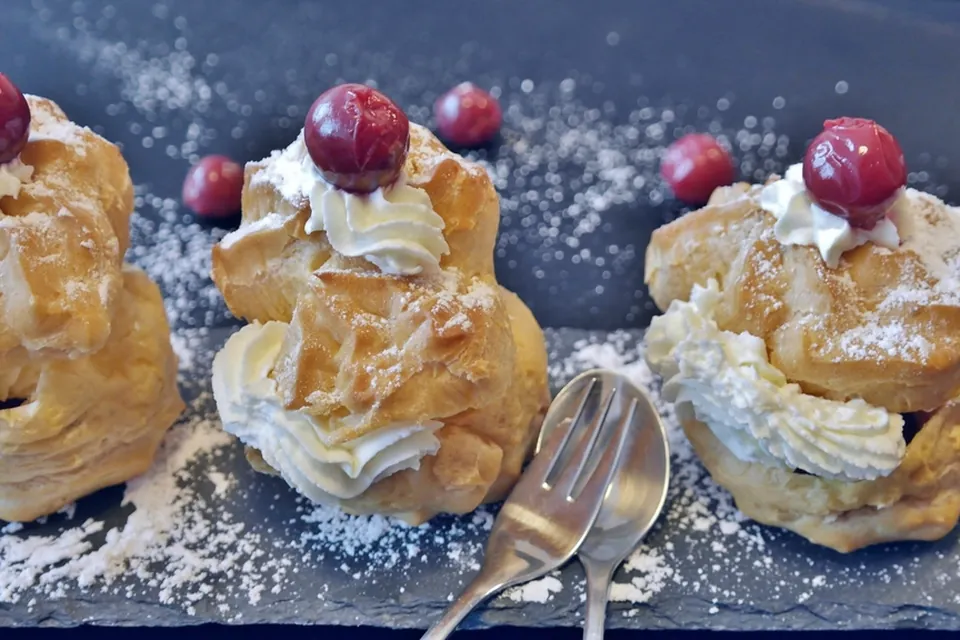
Choux pastry is the dough behind profiteroles, éclairs, gougères and croquembouches. It contains no yeast and no baking powder: it rises because water inside the dough turns to steam in a hot oven and inflates a stretchy, egg-rich shell, which then sets around a hollow centre. Once you understand that, the recipe stops being mysterious and the usual failures become easy to diagnose.
Ingredients (about 30 small puffs or 12 éclairs)
| Ingredient | Weight | Role |
|---|---|---|
| Water | 125 g | Steam for the rise |
| Whole milk | 125 g | Flavour and browning (or use all water for crisper shells) |
| Unsalted butter | 100 g | Tenderness and flavour |
| Salt | 3 g (½ tsp) | Flavour |
| Sugar | 5 g (1 tsp), omit for savoury | Browning |
| Plain flour | 150 g, sifted | Structure (starch and gluten) |
| Eggs | About 250 g (roughly 5 medium), beaten | Stretch, structure, colour |
Weighing makes choux reliable. Cup measures for flour can vary by 20 percent or more, which changes how many eggs the paste can absorb.
Method
- Prepare. Heat the oven to 200 °C conventional (about 180 °C fan; many bakers prefer conventional heat for choux). Line trays with baking paper. Fit a piping bag with a 1 cm plain or star nozzle.
- Boil the liquids. Put water, milk, butter, salt and sugar in a saucepan over medium heat. Bring to a full boil only once the butter has melted, so too much water does not evaporate.
- Add the flour. Take the pan off the heat, tip in all the flour and stir vigorously until a smooth dough forms.
- Dry the panade. Return to medium-low heat and stir for one to two minutes until the dough comes away from the sides and a thin film forms on the base of the pan. This drives off some water so the paste can take more egg.
- Cool slightly. Transfer to a bowl or stand mixer and beat for a minute to release steam. The paste should be warm, not hot, so the eggs do not cook.
- Add eggs gradually. Beat in the eggs a little at a time, waiting until each addition is absorbed. The paste will look broken, then come together glossy.
- Check consistency. Lift the spatula: the paste should fall in a thick ribbon and leave a "V" or triangle hanging. A finger drawn through the paste should leave a groove that slowly closes. Stop adding egg once you reach this point, even if some is left over.
- Pipe. Pipe 3 to 4 cm mounds for puffs or 12 cm lines for éclairs, spaced well apart. Smooth any peaks with a damp fingertip.
- Bake. Bake 15 minutes at 200 °C, then lower to 170 to 180 °C and bake another 15 to 25 minutes until deep golden, including in the cracks. Do not open the door in the first 20 minutes.
- Dry. Pierce each shell with a skewer or the nozzle to let steam out, and return them to the switched-off oven, door ajar, for 10 minutes. Cool on a rack.
Why choux puffs
Cooking the flour in liquid gelatinises its starch, creating a paste that can hold a lot of water and fat without separating. Eggs add proteins that stretch like a balloon and then set with heat. In a hot oven, water in the paste turns to steam, expanding the shell rapidly. The outer layer then sets and browns, and the inside dries. If the oven is opened or the shells come out before the walls have set, the steam condenses, pressure drops and the shell collapses.
Troubleshooting
- Flat, spread puffs: paste too loose (too much egg or an undried panade). Next time, dry the panade a little longer and add the last egg slowly.
- Lopsided or cracked tops: uneven piping or paste too stiff. A thin craquelin disc (butter, sugar and flour) on top gives a neat, even dome.
- Collapsed after baking: underbaked. Bake until deep golden and firm to the touch, then dry with the door ajar.
- Soggy next day: choux absorbs moisture. Store unfilled shells airtight and re-crisp them in a 160 °C oven for 5 minutes; fill just before serving.
- Hollow but eggy taste inside: scoop out any damp interior before filling.
- Pale shells: oven too cool or a fan oven drying the surface before it browns. Check your oven with an oven thermometer.
Variations
- Gougères: omit the sugar, add 100 g grated Gruyère or Comté and a pinch of pepper to the finished paste, and top with more cheese.
- Éclairs: pipe straight lines with a star nozzle, which helps them expand evenly; glaze with fondant or chocolate.
- Craquelin puffs: mix equal weights of soft butter, brown sugar and flour, roll thin, freeze, cut discs and place one on each puff before baking.
- Freezing: pipe unbaked puffs onto a tray, freeze, then bag them; bake from frozen, adding a few minutes.
Fillings and food safety
Crème pâtissière (pastry cream) contains milk, eggs and starch. Bring it to a full boil and keep it bubbling for a minute while whisking, so the starch thickens and the eggs are cooked through, then cool it quickly in a shallow dish with cling film on the surface and refrigerate. Whipped cream and custard fillings are perishable: fill choux as close to serving as possible, keep filled pastries in the refrigerator at 4 °C (40 °F) or below, and do not leave them at room temperature for more than two hours, as advised by US food-safety agencies. Eat cream-filled choux within a day or two.
Equipment
- A heavy-based saucepan, so the panade dries without scorching.
- A sturdy spatula or a stand mixer with a paddle.
- Kitchen scales accurate to the gram.
- An oven thermometer: many ovens run 10 to 20 °C off their dial, which is enough to spoil choux.
- Light-coloured, flat baking trays; dark trays brown the bases faster.
Sources
- USDA Food Safety and Inspection Service, "Danger Zone" (40 °F – 140 °F).
- FoodSafety.gov, Cold food storage charts.
 Pans & bakeware
Choosing a crepe pan
Carbon steel, cast iron or nonstick: diameter, flatness, seasoning and a simple flour test for even heat.
 Ingredients & technique
Black garlic
Weeks of gentle heat turn garlic sweet and jammy. How it works, how to make it, and how to store it safely.
 Pans & bakeware
Bubble waffle makers
Stovetop or electric, plate depth and coatings, and a batter that turns out crisp, hollow bubbles.