Pro-Style Gas Ranges and Range Hoods: Burners, Ovens, Airflow and Make-Up Air
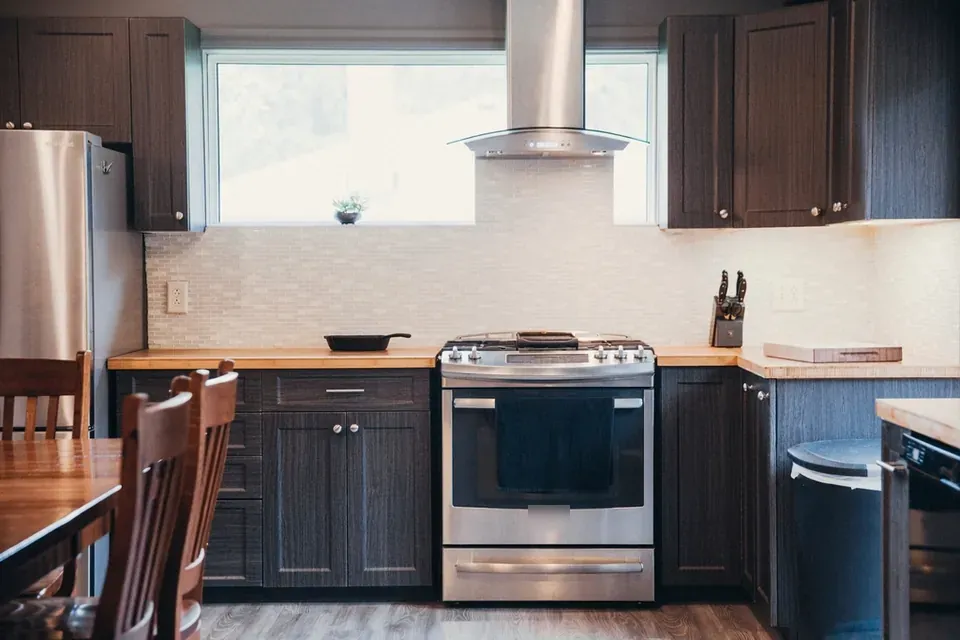
"Pro-style" ranges borrow the look of restaurant equipment: heavy stainless steel, chunky knobs, continuous cast-iron grates and high-output burners. They can be wonderful to cook on, but they are residential appliances with residential limits, and the more heat a range produces, the more the ventilation above it matters. This guide covers what to compare on the range and how to size and install a hood that actually clears the air.
The range: what to compare
| Feature | What it means | What to look for |
|---|---|---|
| Width | Common widths are 30, 36 and 48 inches (76, 91 and 122 cm) | Counter space and hood size follow from this |
| Burner output | Gas input in BTU per hour; high burners on pro-style ranges are often well above standard ranges | At least one high burner for searing and wok cooking |
| Simmer | The lowest stable flame | A dedicated low burner or simmer setting that holds a sauce without scorching |
| Burner type | Sealed (bowl around the burner) or open (drip tray below) | Sealed for easy wiping; open for even, serviceable flame |
| Grates | Continuous cast iron lets pans slide across | Grates you can lift and wash; stable for small pans |
| Oven | Gas or electric (dual-fuel), convection fan, broiler type | Even heat; a reliable thermostat; capacity for your largest tray |
BTU figures are inputs, not results. Burner design, grate height and pan contact decide how much of that heat reaches the food. An oven thermometer is the simplest way to check whether an oven matches its dial; many run hot or cold by 10 to 20 °C.
Installation basics for the range
- Gas connections should be made by a qualified installer, with a leak test afterwards; dual-fuel ranges also need a suitable electrical circuit.
- Follow the manufacturer's clearances to side walls, overhead cabinets and combustible materials.
- Fit the anti-tip bracket supplied with freestanding ranges; the US Consumer Product Safety Commission has reported deaths and injuries from ranges tipping when a child climbs on an open door.
- Pro-style ranges are heavy: check the floor and the delivery route.
Why ventilation matters
Cooking produces heat, water vapour, grease aerosols and fine particles; gas burners also produce combustion products including nitrogen dioxide and carbon monoxide. The US Environmental Protection Agency recommends using range hoods that vent outdoors when cooking, particularly with gas. A good hood also keeps grease off cabinets and ceilings.
Sizing a hood
Width. A hood should be at least as wide as the cooktop. Many designers add about 3 inches (7.5 cm) on each side for wall hoods and more for island hoods, which lose more smoke to cross-draughts.
Height. Follow the manufacturer's installation instructions; typical mounting heights are around 24 to 30 inches (60 to 76 cm) above the cooking surface. Too high and the plume escapes; too low and it gets in the way and heats the hood.
Airflow. Hood capacity is given in cubic feet per minute (CFM) or cubic metres per hour. Common rules of thumb, including those published by the Home Ventilating Institute, are:
| Basis | Rule of thumb |
|---|---|
| Wall hood, by range width | About 100 CFM per linear foot of cooktop |
| Island hood, by range width | About 150 CFM per linear foot |
| Gas range, by burner output | About 100 CFM per 10,000 BTU/h of total burner input |
The burner-output rule gives large numbers for big pro-style ranges. Capture matters as much as airflow: a deep hood with baffle filters and a generous canopy captures more than a shallow, powerful one.
Ducting and make-up air
- Duct size and route. Use the duct diameter the hood maker specifies, rigid smooth metal ducting, as few bends as possible and the shortest route outside. Undersized or long, kinked ducts can halve real airflow and increase noise.
- Termination. End at a proper wall or roof cap with a damper, never into an attic or wall cavity.
- Make-up air. A powerful hood pulls air out of the house that must be replaced. The US International Residential Code (section M1503) generally requires make-up air for kitchen exhaust hoods rated above 400 CFM, and local codes may differ. Without it, the hood underperforms and, in tight houses, can pull combustion gases back down chimneys and flues of other appliances.
- Recirculating hoods filter grease and, with charcoal filters, some odours, but return heat, moisture and combustion gases to the room. Use them only where ducting outside is impossible.
Check a hood at home
- Smoke test. Light a match or incense stick, blow it out and hold it at the front edge of the cooktop with the hood on high. The smoke should be drawn firmly into the hood, not drift into the room.
- Paper test. Hold a sheet of kitchen paper against the filters with the fan on high. It should be held in place by suction.
- Outside check. Go outside and feel for airflow at the wall or roof cap and check the damper opens and closes.
- Make-up air. Run the hood on high with all windows closed. If doors whistle or the fireplace back-draughts, open a window when cooking and talk to a ventilation professional.
- Noise. Compare the setting you actually use with your fridge using a phone sound-meter app. A hood too loud to use is no help.
Filters and cleaning
Stainless baffle filters, common on pro-style hoods, are robust and dishwasher-washable; mesh filters clog faster. Clean filters monthly with regular cooking, more often with frying and wok cooking: grease-laden filters reduce airflow and are a fire risk. Replace charcoal filters in recirculating hoods as the maker specifies, often every few months.
Gas safety
- Fit a carbon monoxide alarm in the home, as recommended by consumer-safety agencies.
- Burner flames should be mostly blue. Persistent yellow, lifting or noisy flames call for a service visit.
- If you smell gas, do not operate switches; leave the home and call the gas emergency number from outside.
Sources
- US Environmental Protection Agency, Indoor air quality, including cooking and combustion pollutants.
- Home Ventilating Institute, residential kitchen ventilation guidance.
- International Code Council, International Residential Code, section M1503 (range hoods and make-up air).
- US Consumer Product Safety Commission, range tip-over and carbon monoxide safety.
 The kitchen
Organising a kitchen
Work zones, a fridge set to 4 °C, pantry rotation and the date-label rules, step by step.
 The kitchen
Cleaning a kitchen properly
Clean first, then sanitise: boards, sponges, a weekly routine, and the products you must never mix.
 Tools & appliances
Air fryers explained
A compact convection oven in a drum: capacity, power, coatings, and a home test with fries and wings.