How to Choose a Santoku Knife: Shape, Steel, Hardness, Edge Angle and Fit
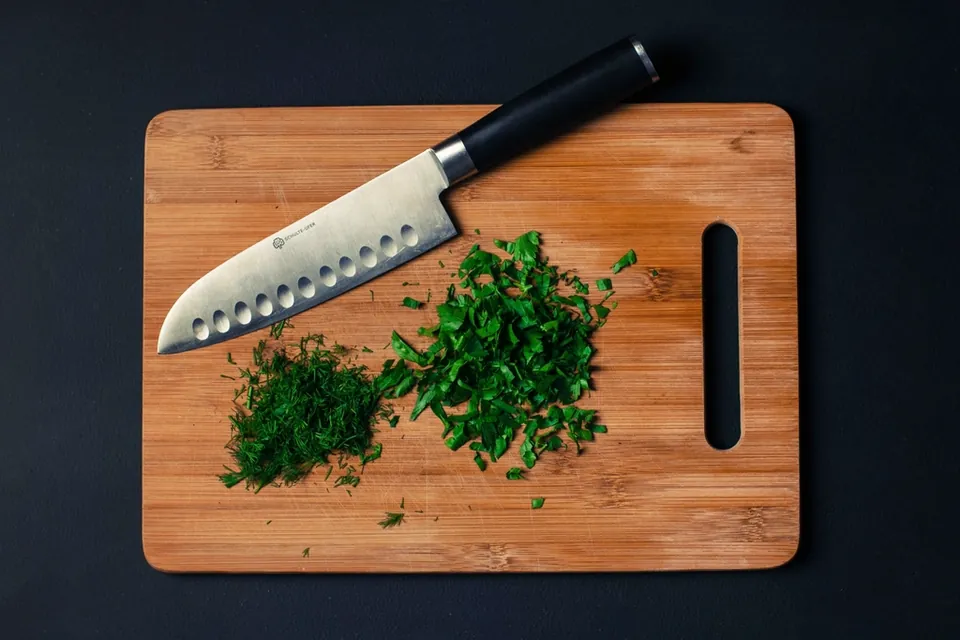
The santoku is a Japanese-style all-purpose kitchen knife with a straight-ish edge, a blunt, downward-curving tip and a tall blade. Its name is usually translated as "three virtues", meaning meat, fish and vegetables, or slicing, dicing and mincing. For many home cooks it is a lighter, less intimidating alternative to a Western chef's knife. Choosing a good one comes down to shape, steel, edge geometry and, above all, how it fits your hand and your way of cutting.
Santoku or chef's knife?
| Santoku | Western chef's knife | |
|---|---|---|
| Typical length | 16.5–18 cm | 20–25 cm |
| Edge profile | Flat with a gentle curve near the tip | Curved belly for rocking |
| Tip | Rounded "sheepsfoot" tip, less pointed | Pointed tip for fine work |
| Cutting motion | Push-cut, chop, pull-slice | Rock-chop, slice |
| Weight | Usually lighter | Varies; German styles heavier |
Neither is objectively better. If you cut mostly vegetables, have smaller hands or a small board, a santoku often feels nimble. If you like rocking through herbs or break down whole chickens, a longer chef's knife may suit you. Many cooks own both.
Steel and hardness
Knife steel involves trade-offs between edge retention, toughness (resistance to chipping), corrosion resistance and ease of sharpening. Hardness is measured on the Rockwell C scale (HRC). It cannot be checked at home, so rely on the maker's stated figure and steel name.
| Steel family | Typical hardness | In practice |
|---|---|---|
| German-style stainless (e.g. X50CrMoV15) | About 55–58 HRC | Tough, forgiving, needs honing often, easy to sharpen |
| Japanese stainless (e.g. VG-10, AUS-10) | About 58–61 HRC | Holds a finer edge longer; can chip on bones or frozen food |
| Powder steels (e.g. SG2/R2) | About 62–64 HRC | Excellent edge retention; harder to sharpen; brittle if misused |
| Carbon steel (e.g. white or blue paper steel) | About 60–64 HRC | Very sharp and easy to sharpen, but rusts and discolours without careful drying |
"Damascus" patterns usually describe a layered cladding around a core steel. The pattern is decorative; performance depends on the core steel and its heat treatment.
Edge angle and blade thickness
The edge angle is measured per side. A 15-degree edge (30 degrees inclusive) slices with less effort than a 20-degree edge but is more delicate. Behind the edge, the thickness of the blade near the cutting edge, often called the grind, matters as much: a thin blade glides through a carrot, a thick one wedges and cracks it. When you sharpen, keep to roughly the angle the maker used, as our sharpening guide explains.
Granton hollows
Many santokus have scalloped hollows along the blade, sometimes called a granton edge or kullenschliff. They are meant to create air pockets that reduce sticking with potatoes or cheese. Their effect is modest and depends on food and technique; a well-ground blade with a slightly convex face can release food as well. Treat hollows as a minor preference, not a reason to buy.
Handle and balance
- Western handles are usually riveted, with a bolster where blade meets handle. Full bolsters add weight and make sharpening the heel harder.
- Japanese "wa" handles are lighter, often octagonal or D-shaped, which moves the balance towards the blade.
- The balance point is usually near where your index finger and thumb pinch the blade. A knife that feels blade-heavy or handle-heavy in your grip will tire you over long prep sessions.
Try a knife at home
- Paper test. Hold a sheet of printer paper by one corner and slice downwards from the heel to the tip. A sharp edge cuts cleanly and quietly; snags show dull or damaged spots.
- Tomato test. Rest the edge on a ripe tomato and draw it back without pressing. A sharp knife bites into the skin immediately.
- Onion test. Dice half an onion. Watch for the knife wedging, sticking or crushing rather than cutting cleanly, and for your knuckles hitting the board (blade height matters here).
- Carrot test. Cut a thick carrot in half crossways. If it cracks before the blade gets through, the grind is thick behind the edge.
- Grip check. Use a pinch grip for ten minutes of prep. Note pressure points on fingers and palm.
Care
- Hand-wash and dry immediately. Dishwashers expose knives to heat, harsh detergent and knocking against other items, which dulls edges and can damage handles. Many makers exclude dishwasher damage from their warranty.
- Use the right board. End-grain or edge-grain wood, or plastic, is kind to edges. Glass, stone, slate and ceramic boards dull knives quickly.
- Hone, then sharpen. A honing rod or fine ceramic rod realigns the edge between sharpenings; harder Japanese steels prefer ceramic or a stone over a ridged steel.
- Store safely. A magnetic strip, block or edge guard protects the edge and your fingers. Loose knives in a drawer get damaged and cause cuts.
- Do not twist or pry. Hard, thin edges chip when used on bones, frozen food or to lever open things.
A note on sets
Knife sets often include pieces you rarely use. A good santoku or chef's knife, a paring knife and a serrated bread knife cover most home cooking. Buy them individually if that means a better main knife.
Sources
- ISO 8442-1, materials and articles in contact with foodstuffs: cutlery and table hollowware, requirements for cutlery for the preparation of food.
- USDA Food Safety and Inspection Service, Cutting boards and food safety.
 Tools & appliances
Sharpening a dull knife
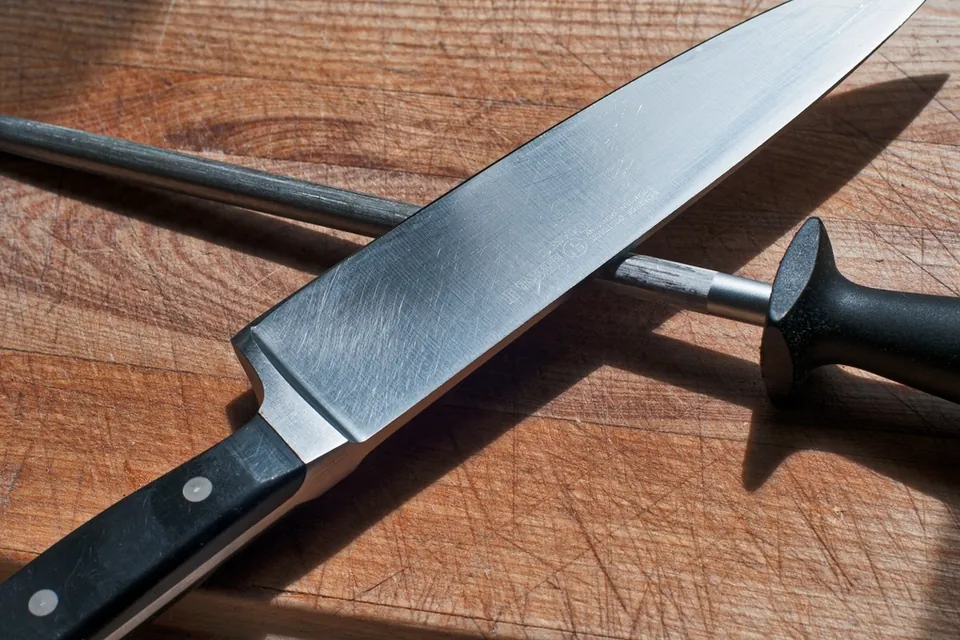
Honing versus sharpening, stones versus pull-through sharpeners, angles, and why dishwashers dull edges.
 Tools & appliances
Choosing a meat slicer
Blade size and type, gearing, guards and standards, and a cleaning routine that keeps Listeria away.
 The kitchen
Organising a kitchen
Work zones, a fridge set to 4 °C, pantry rotation and the date-label rules, step by step.