Countertop Dishwashers: Capacity, Water Supply, Efficiency and Sanitising, Explained
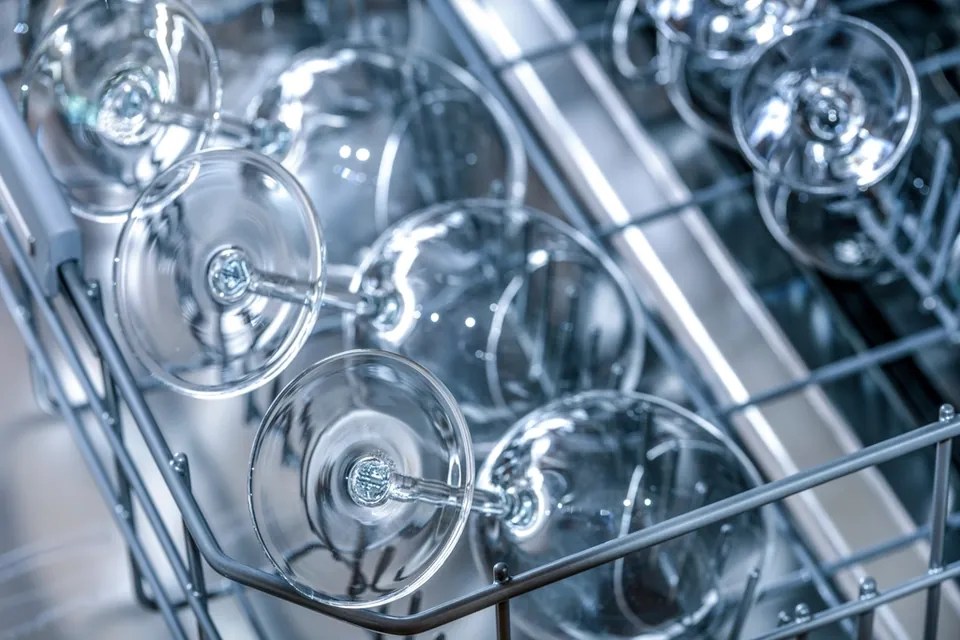
A countertop dishwasher is a small, freestanding machine that sits next to the sink and borrows its water from the tap or from a built-in tank. For renters, small flats and kitchens without a dishwasher space, it can be the difference between washing up by hand three times a day and once. It only works, though, if it fits your counter, your tap and your dishes. Those three checks matter more than any brochure claim.
How they connect
There are two main designs, and the difference shapes daily use.
| Design | How it works | Good for | Drawbacks |
|---|---|---|---|
| Faucet-connected | A hose clips onto an adapter that replaces the tap's aerator; a second hose drains into the sink | Daily use; no refilling | Ties up the tap during cycles; many pull-out and sensor taps are incompatible |
| Built-in tank | You pour a few litres of water into a reservoir before each cycle | Any tap, caravans, offices, rentals | Refilling every time; some models still need a drain route |
| Drawer or slimline built-in | Plumbed-in like a full machine, in a drawer or 45 cm wide cabinet | Small kitchens with cabinet space | Installation; cost |
Because a faucet-connected machine fills with water from your hot or mixed supply, check the manual for the recommended inlet temperature. Many machines also heat water internally.
Fit: three measurements
- Height under the wall cabinets. Countertop machines are often around 43 to 50 cm tall, and the door opens downwards, so you also need depth in front of the machine to load it.
- Distance to the sink. Inlet and drain hoses are short. The drain hose must reach the sink and, usually, run downhill all the way.
- Your largest items. Measure the diameter of your dinner plates and the height of your tallest glasses and compare them with the maximum sizes in the manual. Large plates are the most common reason a small machine disappoints.
Efficiency labels
In the United States, the Department of Energy sets minimum efficiency standards separately for standard and compact dishwashers, and ENERGY STAR certifies models that do better. ENERGY STAR treats a dishwasher as compact when it holds fewer than eight place settings, which covers countertop machines. In the EU and UK, the energy label grades dishwashers from A to G and states energy per 100 cycles and water per cycle on the standard "eco" programme. Compare like with like: the eco programme is long and cool by design, and other programmes use more energy.
Sanitising and hygiene
NSF/ANSI 184 is the North American standard for residential dishwashers that claim to sanitise. To be certified, a machine's sanitising cycle must reach a final rinse of at least 150 °F (65.5 °C) and achieve a 99.999 percent (five-log) reduction of test bacteria. A machine without the certification may still clean well; it simply has not had that claim verified. Whatever the machine, the filter needs regular cleaning, and leaving the door ajar after a cycle helps the interior dry and discourages odours and mould.
Test it at home
- Dry run load. Before the return period ends, load it with a real day's dishes: plates, bowls, two pans, glasses, cutlery. Note what does not fit.
- Soil test. Smear a plate with egg yolk, another with porridge and a mug with coffee, and leave them to dry for two hours. Run the normal programme and inspect in good light. Dried egg and starch are classic hard soils.
- Spray coverage. Put a sheet of paper towel in an empty upper corner of the rack weighted with a spoon. If it is barely damp after a cycle, spray reach to that corner is weak.
- Drying. Count water drops left on plastic tubs and glasses. Plastics dry poorly in every dishwasher; glass and ceramics should be largely dry.
- Noise. A phone sound-meter app is not calibrated, but used from the same spot it lets you compare the machine with your fridge or extractor fan.
- Leaks. Lay paper towel under the hose connections and the front of the machine for the first few cycles.
What should not go in
- Good kitchen knives: heat, detergent and knocking against other items dull and corrode edges and can damage handles. See our knife care guide.
- Cast iron, carbon steel, wooden boards and utensils, and most nonstick pans unless labelled dishwasher-safe.
- Insulated travel mugs, crystal and hand-painted china, unless the maker says otherwise.
- Thin plastics on the bottom rack, close to the heating element.
Detergent and water hardness
Use dishwasher detergent only, never washing-up liquid, which foams and can leak out of the door. Small machines may need less detergent than a full-size one; the manual gives the dose. In hard-water areas, limescale builds up on glasses and the heating element; rinse aid and, where the machine has one, a salt reservoir set to your water hardness help. A periodic empty cycle with a dishwasher cleaner or citric acid removes deposits.
Safety
Dishwasher detergents, pods especially, are a known poisoning risk for young children. The US Consumer Product Safety Commission advises keeping them in their original container, out of sight and reach. Loading knives point-down in the cutlery basket also prevents cuts when unloading.
Bottom line
Measure first, then compare. A modest faucet-connected machine that fits under your cabinets, takes your plates and carries ENERGY STAR will serve better than a feature-packed one that blocks the tap you use most. If you have a free cabinet, a slimline or drawer dishwasher may be the better long-term answer.
Sources
- ENERGY STAR, Dishwashers: key product criteria.
- US Department of Energy, Appliance and Equipment Standards Program.
- NSF International, NSF/ANSI 184 residential dishwashers.
- US Consumer Product Safety Commission, laundry and dishwasher pod safety.
 The kitchen
Organising a kitchen
Work zones, a fridge set to 4 °C, pantry rotation and the date-label rules, step by step.
 The kitchen
Cleaning a kitchen properly
Clean first, then sanitise: boards, sponges, a weekly routine, and the products you must never mix.
 Tools & appliances
Sharpening a dull knife
Honing versus sharpening, stones versus pull-through sharpeners, angles, and why dishwashers dull edges.